
MCHHS Earns Top Robotic Surgery Practice Award 2026
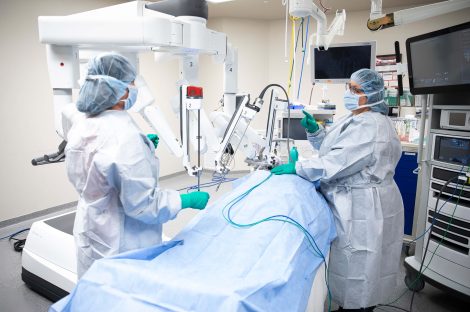
Access to advanced surgical care should not depend on geography. For many rural communities, however, distance still shapes whether patients can access timely treatment.
Mitchell County Hospital Health Systems (MCHHS) built its robotic-assisted surgery program around that reality, bringing robotic-assisted minimally invasive surgery closer to home for
patients across North Central Kansas.
That commitment has positioned MCHHS as one of only three Critical Access Hospitals in Kansas offering robotic care. As the program approaches its one-year mark, advanced
minimally invasive procedures are no longer an exception reserved for urban referral centers. They are becoming a routine option in community hospital settings, reducing the need for long-distance travel for patients.
“Our vision is to deliver exceptional healthcare for the rural people,” says Janelle Kircher, CEO. “Investing in surgical robotics was a strategic decision. That decision has spared patients more than an hour of travel to receive advanced surgery.”
Urban-Level Robotic Precision for Rural Care
MCHHS uses the da Vinci Xi robotic-assisted surgical system for advanced robotic surgery. The system offers refined instrument control and a magnified, high-definition 3D view of the surgical field for the surgeons. Unlike traditional open surgeries, which require large incisions or even standard laparoscopic procedures, the da Vinci system uses small instruments that allow for greater flexibility and precision.
The system’s Firefly imaging technology strengthens intraoperative patient safety by improving anatomical visibility during robotic procedures. Using near-infrared fluorescence with indocyanine green, Firefly helps surgeons visualize structures such as the common bile duct and ureter in real time during surgery. That added visibility improves anatomical identification, supports real-time detection of bile leaks and reduces the risk of injury in procedures where clear confirmation matters most.
Beyond imaging, the da Vinci Xi allows the surgical team to manage higher-complexity cases locally. Patients with obesity or challenging anatomy, who might otherwise require referral
to a distant centre, can now receive advanced care close to home without compromising outcomes.
“We use robotics because it’s a win for the patients and us. It gives surgeons greater precision, and that translates into better outcomes for patients,” says Danny Owens, general surgeon.
In one case, the surgical team removed an obstructing colon cancer in a morbidly obese patient using this technology. The approach enabled the patient to begin chemotherapy sooner while reducing the risk of wound infection and hernia formation.
Clinical Preparedness for Advanced Rural Surgery
Robotic-assisted surgery changes rural healthcare only when it becomes dependable—repeatable enough to feel routine, not rare.
“We provide the same robotic technology on the same platform used in urban areas to positively impact patient care. As medicine advances, so do improved outcomes, partially due to innovation and technology,” says Mark Banker, general surgeon.
Surgeons complete simulations, tissue models and more than 50 proctored cases before practicing independently, while nursing teams undergo formal education and certification to
support robotic procedures. The result is an operating room where safety and consistency are structured into preparation, not improvised case by case.
Two full-time general surgeons provide daily coverage, enabling patients to move from evaluation to treatment without extended wait times. Access remains driven by clinical need, because scheduling limitations do not dictate care decisions.
Operational discipline connects training and staffing to day-to-day execution. Surgical schedules, room preparation and robotic setup are planned deliberately so procedures start on time and teams operate within a familiar workflow. Data captured through the da Vinci Xi system, including case volume, operative times and performance feedback, is reviewed regularly to sustain repeatable performance standards as robotic-assisted surgery becomes part of routine practice rather than an exception.
All of that reflects MCHHS’s larger philosophy of rural healthcare strength: technology is not pursued for optics. It is adopted with preparation, reinforced by process and shaped around the continuity patients depend on. By aligning advanced capability with rural realities, MCHHS demonstrates that critical-access hospitals can deliver high-standard surgical care, without forcing patients to travel elsewhere for the same level of treatment.